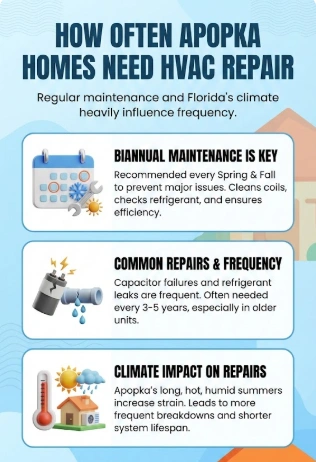
Apopka homes need HVAC repairs more often than you might expect—and local climate is the reason. Based on service patterns across Central Florida, most systems here require professional attention one to two times annually, with older units often needing three or more calls per year.
Our technicians see the same issues repeatedly in Apopka: capacitor failures from constant runtime, clogged condensate drains from relentless humidity, and refrigerant leaks accelerated by systems that rarely cycle off during eight-month cooling seasons. These aren't maintenance failures—they're the reality of running HVAC equipment in a subtropical climate.
This guide covers actual repair frequencies for Apopka homes, the climate factors driving them, and warning signs local homeowners should recognize before small problems become emergency calls.
Quick Answers
HVAC Repair in Apopka
Short answer: Apopka homeowners typically need HVAC repairs 1–2 times per year with proper maintenance. Central Florida's subtropical climate pushes systems harder than almost anywhere else in the country.
What we see locally:
Most common repairs: Capacitor failures, clogged drain lines, refrigerant leaks
Primary cause: Systems running 2,500–3,000+ hours annually with minimal rest
Peak repair season: May through September when cooling demand is highest
Before scheduling service:
Verify contractor license at myfloridalicense.com
Confirm permits will be pulled for replacements
Check OUC rebates for system upgrades ($45–$1,150 available)
Reduce repair frequency by:
Changing filters monthly during cooling season
Scheduling annual tune-ups before summer
Addressing warning signs immediately
Bottom line: Frequent repairs in Apopka reflect climate demands—not equipment defects. Proactive maintenance costs less than emergency calls during July heat waves.
Top Takeaways
Expect one to two HVAC repairs per year with proper maintenance—three or more for older systems without regular service.
Central Florida systems log 2,500–3,000+ runtime hours annually versus 1,200–1,500 hours in northern climates.
Capacitor failures, clogged condensate drains, and refrigerant leaks top local service tickets due to constant cycling and humidity.
Monthly filter changes and annual tune-ups keep repair frequency at the lower end of the range.
Always verify contractor licenses through the Florida DBPR portal and confirm permits are pulled for any HVAC replacement.
What Drives HVAC Repair Frequency in Apopka Homes
Most Apopka homeowners need HVAC repairs one to two times per year with proper maintenance—though older systems often require three or more service calls annually. The difference comes down to our Central Florida climate. Cooling seasons stretch eight to nine months here, meaning local systems log 2,500 to 3,000+ runtime hours compared to 1,200 to 1,500 hours in northern states. That constant operation accelerates wear on capacitors, contactors, and compressors far beyond what manufacturers anticipate.
The repairs we see most often reflect these conditions: capacitor failures from relentless cycling, clogged condensate drains from humidity-driven algae growth, and refrigerant leaks from systems that rarely shut off. These aren't signs of defective equipment—they're predictable wear patterns for HVAC units working under Apopka's demanding subtropical conditions.
Homeowners who change filters monthly and schedule annual tune-ups typically stay at the lower end of that repair range. Those who skip routine maintenance or run systems past the ten-year mark should expect more frequent service calls, especially during peak summer demand.
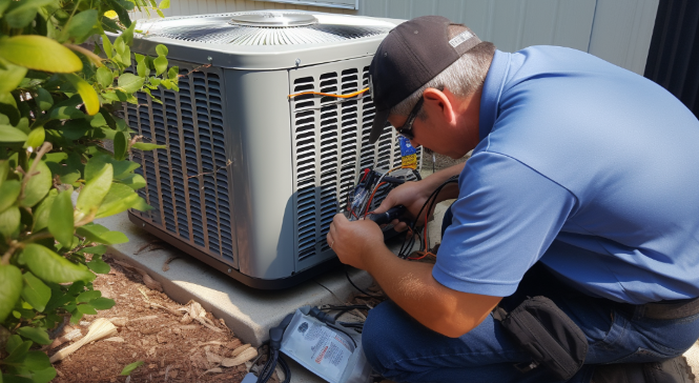
"After servicing Apopka homes for over 15 years, we've learned that repair frequency here has less to do with equipment quality and more to do with runtime—local systems work twice as hard as units up north, and that wear shows up on our service tickets every summer."
Essential Resources for Apopka HVAC Repair Decisions
Verify Contractor Licenses Before Hiring
The Florida DBPR License Verification Portal confirms any HVAC contractor's active license status, expiration date, and disciplinary history. Florida law requires all HVAC work be performed by licensed professionals—this free tool protects homeowners from unlicensed operators.
Resource: Florida Department of Business and Professional Regulation URL: https://www.myfloridalicense.com/wl11.asp
Understand Orange County Permit Requirements
Orange County's Mechanical Permit page outlines requirements for HVAC replacements, change-outs, and major repairs. All HVAC installations in Apopka require permits and inspections to ensure Florida Building Code compliance.
Resource: Orange County Division of Building Safety URL: https://www.orangecountyfl.net/PermitsLicenses/Permits/MechanicalPermit.aspx
Claim Available Utility Rebates
OUC offers Apopka homeowners $45–$1,150 in rebates for qualifying heat pump and high-efficiency AC installations. Additional rebates cover duct sealing, insulation upgrades, and ENERGY STAR equipment.
Resource: Orlando Utilities Commission Rebate Program URL: https://www.ouc.com/solutions-programs/savings/rebates/
Compare HVAC Efficiency Ratings
The ENERGY STAR Heating and Cooling Guide explains SEER, EER, and HSPF ratings that determine system efficiency and operating costs. Higher-rated equipment reduces energy bills significantly in Florida's extended cooling season.
Resource: U.S. Environmental Protection Agency – ENERGY STAR URL: https://www.energystar.gov/saveathome/heating-cooling
Review Indoor Air Quality Guidelines
EPA publications cover HVAC maintenance best practices, filtration standards, and humidity control for healthy indoor environments. Central Florida's climate makes proper IAQ management essential for both comfort and health.
Resource: U.S. Environmental Protection Agency – Indoor Air Quality URL: https://www.epa.gov/indoor-air-quality-iaq/publications-about-indoor-air-quality
Check Contractor Complaint History
The Better Business Bureau maintains ratings, reviews, and complaint records for HVAC companies serving Central Florida. Cross-referencing BBB profiles with DBPR license status identifies reputable contractors.
Resource: Better Business Bureau – Central Florida URL: https://www.bbb.org/us/fl
Confirm Federal Efficiency Standards
The Department of Energy sets minimum efficiency requirements for all HVAC equipment sold in the United States. Florida falls under Southeast regional standards requiring higher SEER2 ratings than northern states.
Resource: U.S. Department of Energy – Energy Efficiency Standards URL: https://www.energy.gov/energysaver/central-air-conditioning
Supporting Statistics
Federal data confirms what we observe daily on Apopka service calls. Central Florida's climate creates HVAC demands unlike anywhere else in the country.
27% of Home Energy Costs Go to Air Conditioning in Hot-Humid Regions
Our customers often ask why their energy bills run higher than family up north. The data explains it:
National average: 12% of home energy costs go to cooling
Hot-humid regions (Central Florida): 27% of energy costs go to cooling
AC usage rate in our climate zone: 94% of households
When systems run nearly year-round while northern units sit idle for months, the repair frequency difference makes sense.
Source: U.S. Energy Information Administration URL: https://www.eia.gov/todayinenergy/detail.php?id=36692
20–30% of Conditioned Air Is Lost Through Duct Leaks
We routinely find Apopka attic ductwork losing cooled air before it reaches living spaces. Federal estimates confirm what we see:
Typical air loss: 20–30% through leaks and poor connections
Efficiency gain from sealing: Up to 20%
Florida attic temperatures: Often exceed 140°F in summer
When a system loses a third of its output just to maintain temperature, components wear faster. Repairs become more frequent.
Source: U.S. Environmental Protection Agency – ENERGY STAR URL: https://www.energystar.gov/saveathome/heating-cooling/duct-sealing
70–90% of Installed HVAC Systems Have Performance-Compromising Faults
This statistic surprises homeowners—but it matches our field experience exactly.
DOE research found:
70–90% of residential AC/heat pump systems have at least one performance fault
Common causes: installation shortcuts and skipped maintenance
With duct leakage factored in: 90–100% of systems affected
When we diagnose inefficient systems in Apopka homes, we rarely find defective equipment. We find systems that were never set up correctly for our climate demands.
Source: U.S. Department of Energy – Building Technologies Office URL: https://www.energy.gov/eere/buildings/articles/residential-hvac-installation-practices-review-research-findings
Final Thought & Opinion
After years of servicing HVAC systems throughout Apopka, one truth stands out: repair frequency here has less to do with equipment quality and everything to do with operating conditions.
Homeowners often feel frustrated when systems need attention more than once a year. They assume something is wrong. In most cases, it isn't. HVAC equipment in our climate works harder in six months than systems in moderate climates work in two years.
What we've learned from thousands of local service calls:
Homeowners who experience the fewest repairs share three habits:
Change filters monthly during cooling season—not quarterly
Schedule annual tune-ups before summer heat arrives
Address small warning signs immediately instead of waiting for failures
Homeowners who call us most frequently tend to:
Skip routine maintenance
Run systems past 12–15 years without replacement planning
Inherit poorly installed equipment when purchasing older homes
Our advice for every Apopka homeowner:
Budget for one to two professional service visits per year
Treat that frequency as normal—not as a sign of problems
Remember: systems running in 90°F heat with 80% humidity for eight months need more attention than national guidelines suggest
That's not a flaw in the equipment. That's Florida.
Bottom line: Proactive maintenance almost always costs less than emergency repairs during a July heat wave. Use the resources on this page to make informed decisions—and plan ahead.
FAQ on "HVAC Repair in Apopka"
Q: How often do Apopka homes typically need HVAC repairs?
A: Based on our service records across Central Florida:
Well-maintained systems: 1–2 repairs per year
Systems over 10 years old: 3+ repairs per year
Systems without regular tune-ups: 3+ repairs per year
Apopka systems run 2,500+ hours annually. Repair needs here exceed national averages—and that's normal.
Q: What are the most common HVAC repairs in Apopka?
A: Our technicians diagnose the same issues week after week:
Capacitor failures from relentless cycling
Condensate drain clogs caused by algae thriving in humidity
Refrigerant leaks from systems that rarely rest
These aren't random failures. They're predictable wear patterns for Central Florida equipment.
Q: How do I verify an HVAC contractor is licensed in Florida?
A: We encourage homeowners to check before signing any agreement.
Visit the Florida DBPR portal at myfloridalicense.com
Enter the contractor's name or license number
Review active status, expiration date, and complaint history
Reputable contractors display license numbers on trucks, websites, and estimates without hesitation.
Q: Do HVAC repairs in Apopka require permits?
A: For most replacements and major repairs—yes.
Orange County requires mechanical permits for:
System change-outs
New installations
Ductwork modifications
We handle permits on every qualifying job. Skipping this step creates problems during home sales and insurance claims. If a contractor suggests avoiding permits, consider that a red flag.
Q: How can I reduce how often my Apopka HVAC system needs repairs?
A: The homeowners we visit least often share three habits:
Change filters monthly during cooling season
Schedule annual tune-ups before summer arrives
Address warning signs immediately—unusual noises, weak airflow, warm air from vents
This approach keeps repair frequency low and avoids emergency calls during peak July heat.
Here is the nearest branch location serving the Royal Palm Beach FL area…
Filterbuy HVAC Solutions - West Palm Beach FL
1655 Palm Beach Lakes Blvd ste 1005, West Palm Beach, FL 33401
(561) 448-3760