TL;DR
Check a 10x30x2 air filter monthly and replace it every 90 days at most. Its narrow face has less surface area than square filters, so it can clog before the 90 days on the package. Homes with pets, allergies, or year-round AC should plan on 45 to 60 days.
Key Takeaways
• Replace a 10x30x2 at least every 90 days and check it monthly, as ENERGY STAR recommends.
• A 10x30 filter has about 300 square inches of face area, compared with 500 for a 20x25, so each square inch catches more dust.
• Pets, allergies, renovation dust, and long cooling seasons shorten the interval to 45 to 60 days.
• Gray pleats, a bowed frame, weak vent airflow, and longer run cycles mean the filter is loaded.
• Changing every 60 days instead of 90 adds only about $23 a year.
How Often Should You Change a 10x30x2 Air Filter?
Change a 10x30x2 air filter every 60 to 90 days in a typical home, and every 45 to 60 days with pets, allergies, or heavy AC use. ENERGY STAR's HVAC maintenance guidance calls for a monthly check and a change at least every three months, because a dirty filter raises energy costs and can damage equipment.
Climate shifts the schedule. In South Florida, the AC can run nine or more months a year, pulling more air and dust through the filter than a seasonal climate would.
"Down here, the AC barely gets a day off. I tell neighbors to treat the 90 days on the package as the longest they should wait, not the goal," says Katelyn Redish.
Does a 2-Inch Filter Last Longer Than a 1-Inch?
Yes, when the face size is the same, but face area matters just as much as depth. A 2-inch frame holds more pleated media, so it traps more dust before airflow drops. Many 2-inch filters are sold as 90-day filters, while 1-inch filters are often rated for 30 to 90 days.
Why Does a Narrow 10x30 Frame Load Faster?
A 10x30x2 loads faster than a square filter of the same depth because it has less face area. Its actual size, 9.5 x 29.5 inches, gives about 280 square inches, while a 20x25 has 500. When similar airflow moves through less area, air passes through each pleat faster and dust builds up sooner.
Our rule of thumb: compare face area before trusting a filter's day rating. For a 10x30x2, treat 90 days as the ceiling, not the target.
What Is a Realistic 2-Inch Filter Replacement Schedule?
Start at 90 days and shorten it for each factor that applies to your home:
No pets, mild use: 90 days
One pet: about 60 days
Allergies, asthma, multiple pets, or smokers: about 45 days
Renovation, sanding, or wildfire smoke: check every 2 weeks until conditions clear
Year-round AC, as in South Florida: use the shorter end of your range
These intervals match Filterbuy's guidance for its 10x30x2 filters: about two months with pets and six weeks with allergies or asthma.
Filter Change Interval With Pets
Fur and dander collect fast on the side of the filter facing incoming air, especially during spring and fall shedding. If you see a mat of hair on the surface, change the filter no matter how many days it's been.
When Should You Replace a Furnace Filter?
Replace a furnace filter on the same schedule as your AC filter, because in most central-air homes they are the same filter. One filter protects the blower for both heating and cooling. Change it before each heavy-use season and at every spring and fall tune-up. For more on filter types, see our guide on how often to change furnace filters.
Signs a Filter Is Loaded
Change the filter now, whatever the calendar says, if you see:
Gray or brown pleats with no original color showing
A frame that bows inward or sits loose in its slot
Weaker airflow from the vents, or rooms that stay warm
Longer run cycles or a rising energy bill
Frost on the indoor refrigerant line, which signals restricted airflow and warrants a service call
Our 30-second monthly check:
Write the install date on the filter frame with a marker.
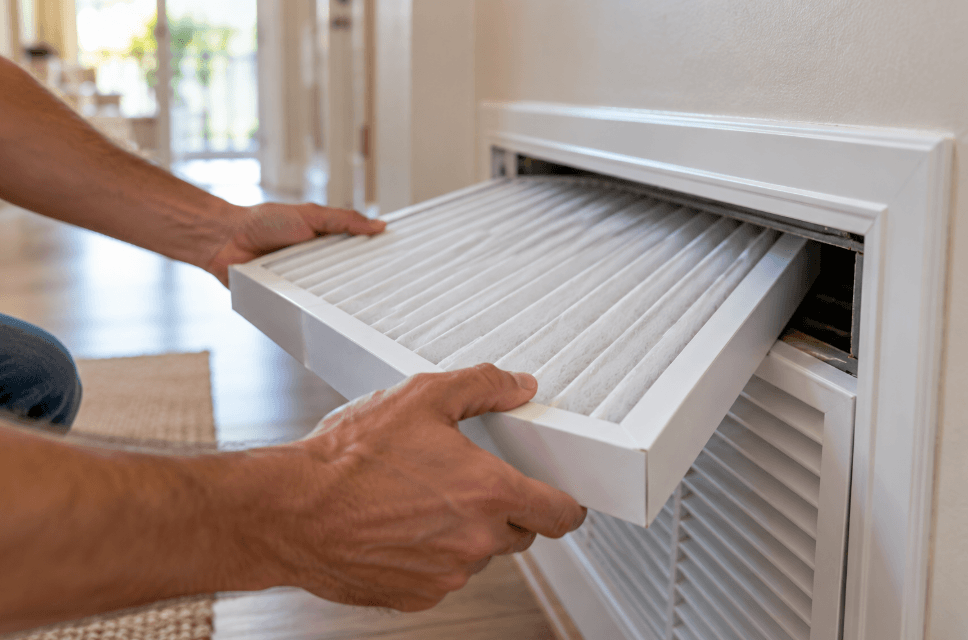
Turn the system off and slide the filter out.
Check the side facing away from the blower. Gray pleats mean it's time.
Make sure the frame is flat and fits snugly.
Reinstall it with the airflow arrow pointing toward the blower.
How Do You Choose the Right 10x30x2 Replacement?
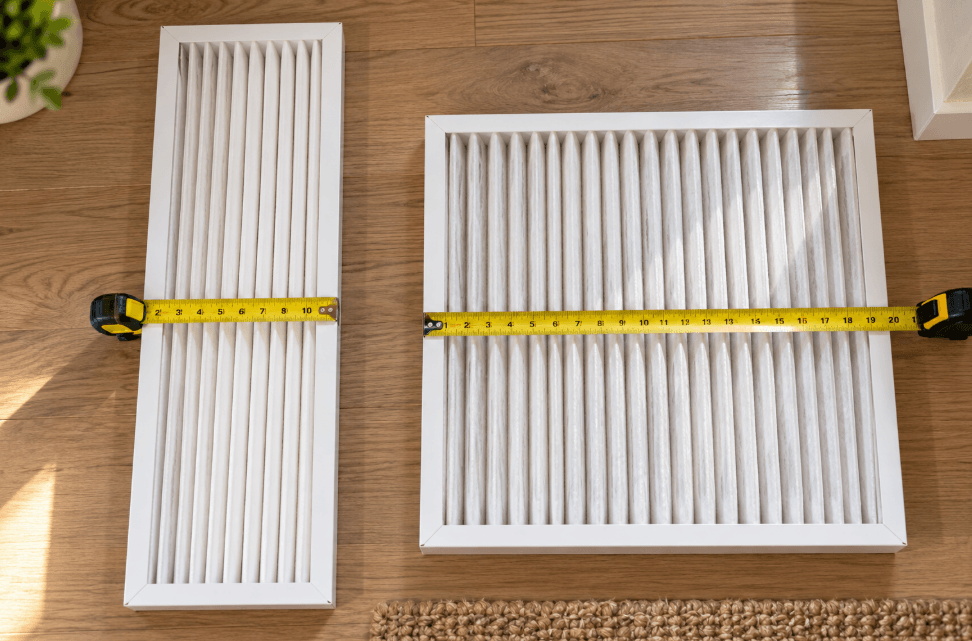
Buy the exact size, then match the MERV rating to your household: MERV 8 for everyday dust, MERV 11 for pets or allergies, and MERV 13 for finer particles like smoke. The EPA's Guide to Air Cleaners in the Home says most systems can handle MERV 13 as long as it's replaced frequently, so pair MERV 13 with a shorter interval. If a label shows FPR instead of MERV, our Filter Performance Rating (FPR) overview explains the difference.
Avoid three sizing mistakes:
Number order: A 30x10x2 is the same filter as a 10x30x2.
Exact measurement: 10x30x2 is the nominal size. The actual filter is about 9.5 x 29.5 x 1.75 inches so it slides into the slot.
Wrong depth: A 1-inch filter in a 2-inch slot leaves a gap for unfiltered air. The EPA says filters should fit snugly.
Filterbuy is a U.S. air filter manufacturer based in Talladega, Alabama, that makes pleated HVAC filters in hundreds of sizes, including the 10x30x2 in MERV 8, 11, and 13. As the company puts it on its product page, "In our experience, we've found that not all filters perform the same." Filterbuy rates its 10x30x2 pleated filters as three-month filters.
What Does Changing a 10x30x2 More Often Cost?
At about $11.66 per filter in a six-pack (Filterbuy pricing, checked September 2026), one 10x30x2 costs:
Every 90 days: about $47 a year
Every 60 days: about $70 a year
Every 45 days: about $93 a year
Moving from 90 to 60 days adds about $23 a year. The Department of Energy says replacing a clogged filter can cut AC energy use by 5% to 15%, which can offset the extra filters in a hot climate. Prices change, so check before you budget.
Supporting Statistics
1. Heating and Cooling Make Up Nearly Half of Home Energy Costs
The average U.S. home spends nearly $1,900 a year on energy, and nearly half goes to heating and cooling. ENERGY STAR names dirt and neglect as the top causes of heating and cooling system failure.
Source: ENERGY STAR (energystar.gov)
2. People Spend About 90% of Their Time Indoors
The EPA reports that most people spend about 90% of their time indoors, mostly at home, where much of their exposure to airborne pollutants happens. It also warns that a dirty, overloaded filter won't work well.
Source: U.S. Environmental Protection Agency (epa.gov)
3. Nearly Half of U.S. Households Have a Dog
Dog-owning households made up 45.5% of U.S. households in 2024, and cat-owning households made up 32.1%, according to preliminary AVMA survey data. Those homes need the shorter 45 to 60 day interval.
Source: American Veterinary Medical Association (avma.org)
Essential Resources on “10x30x2 Air Filters”
1. Confirm the Exact Fit and Filter Options for Your 10x30x2
Filterbuy's 10x30x2 Air Filters page lists the filter's actual dimensions (9.5 x 29.5 x 1.75 inches), its MERV 8, 11, and 13 options, and replacement intervals for homes with pets, allergies, or young children.
Source: Filterbuy · https://filterbuy.com/air-filters/10x30x2/
2. Match the MERV Rating to What You Need to Filter
The EPA's MERV rating explainer shows which particle sizes each MERV level captures, so you can choose between MERV 8, 11, and 13 with confidence.
3. Understand Why Fine Particles Matter for Your Health
The EPA's Indoor Particulate Matter page explains how inhalable particles affect the heart and lungs and who faces greater risk, including people with asthma, children, and older adults.
4. Change Your Filter Correctly
ENERGY STAR's guide to keeping your HVAC system efficient walks through a filter change step by step, including which way the airflow arrow should point.
5. Cut Cooling Costs With a Clean Filter
The Department of Energy's air conditioner maintenance guide reports that replacing a clogged filter can lower AC energy use by 5% to 15%, and it advises more frequent changes with pets, dust, or constant use.
Final Thoughts
With a 10x30x2, the package label can mislead you: the 2-inch depth suggests a long life, but the narrow face often means an earlier change. Check it monthly, let the pleats tell you when it's done, and treat 90 days as the limit.
Next Steps
1. Set a monthly phone reminder to check your filter.
2. Put change dates on your calendar: the first of January, April, July, and October for 90 days, or every other month for 60 days. In South Florida, time one change for May 1, before peak cooling season.
3. Write the install date on each new filter's frame.
4. Keep a spare 10x30x2 on hand so a change never waits on a delivery.
5. At your next tune-up, ask your technician which MERV rating your system can handle.
Frequently Asked Questions
Is 90 days too long for a 10x30x2 filter?
Ninety days is fine for a low-dust home with no pets. For most other homes, especially in hot climates, 60 days is the safer interval, since 90 days is an upper limit rather than a guarantee.
Can I vacuum and reuse a pleated 10x30x2 filter?
No. Vacuuming removes surface dust, but fine particles stay embedded in the media, so airflow remains restricted.
Where is a 10x30x2 filter usually located?
Central air filters sit along the return duct. The Department of Energy notes common spots in walls, ceilings, or the air conditioner itself. A long, narrow size like 10x30 often sits behind a wall or ceiling return grille, and some homes have more than one, so check each grille.
Do I need to turn off the system to change the filter?
Yes. ENERGY STAR recommends turning off the furnace, AC, and fan at the thermostat, breaker, or unit switch before you remove the filter.
Schedule a Tune-Up
If your filter clogs faster than expected or airflow stays weak after a change, the problem may go beyond the filter. Schedule a tune-up, and a technician can check your system's airflow and confirm the right filter for your home.
Glossary
10x30x2 filter: A 10-by-30-inch HVAC air filter with a 2-inch-deep frame.
Face area: The width times the height of a filter's front surface. More face area spreads airflow and dust over more media.
MERV: Minimum Efficiency Reporting Value, a 1 to 16 scale for how well a filter captures particles. Higher numbers catch smaller particles.
Learn more about HVAC Care from one of our HVAC solutions branches…
Filterbuy HVAC Solutions - West Palm Beach FL
1655 Palm Beach Lakes Blvd., Ste 1005 West Palm Beach, FL 33401
(561) 448-3760
https://maps.app.goo.gl/VarpgNZnxuPQuW8A7